

52 weeks, 52 books, and counting...
Monday, September 26, 2011
The Screwtape Letters by C.S. Lewis


Thursday, September 22, 2011
The Prime Ministers by Yehuda Avner

The Prime Ministers by Yehuda Avner is an in depth perspective of the early stages of the State of Israel's history from the point of view of, what Avner calls, a “fly on the wall”. Working closely with four Prime Ministers from Levi Eshkol to Menachem Begin, Avner gives the reader a very close perception of the situations that occurred in Israel during its beginnings that one cannot get elsewhere.
Avner opens his discussion with the intricacies of the fight between Irgun and the Hagana. What I found most interesting was what could have come about from this bout, especially at the aftermath of the Hagana's bombing of the Irgun arms ship Altalena and the rounding up of the Irgun members. Considering the dire situation that the entire Jewish population was in at the time it seems the worst time to create a civil war between the two factions. At the same time the ideologies on how to deal with the British were so drastically different that it was up to the greatness of Menachem Begin to stop fighting. In both cases, Avner describes how Begin was so opposed to the idea of Jews fighting Jews that he completely gave in to the Haganah. This will lead the way to later in the book, where Avner clearly has a love for Begin, considering him the greatest Israeli Prime Minister. Another thing he focuses on is life in the Kibbutzim. The hardships that many people needed to face to start up the country from rocks and swamps is simply remarkable. It is completely a testament to the passion for the land of Israel that they had that the economically rising nation that exists today even had a chance.
The first Prime Minister that Avner really has a close relationship with is Levi Eshkol. Although he was the Prime Ministers during the 1967 war, he is not one spoken about frequently. What is clear from the narrative is that the people had an almost negative perception of Eshkol throughout most of his premiership. He did not seem to be a powerful and strong leader, exemplified by a horrible radio address, after which, many wanted him out of power. Based on the way he is portrayed in this book, this is unfortunate. His ambivalence, however, sometimes had great power. Unlike many leaders, he was one that definitely was willing to hear the other side. Even when Begin wanted him to step down, Eshkol was willing to hear him through, and even though he eventually stayed in as Prime Ministers, his ability to hear the opposition is a tremendous quality. It is possible that this great quality comes from the fact of not being so stubborn on all of your positions. When to have this quality and when not to is the problem that we all face. Another time where this was indispensable was during the 1967 war. He followed Begin's (who was the opposition leader) idea to take over Yerushalayim despite both his and Moshe Dayan's hesitation. This quick change of stance lead to the control of Yerushalayim that we enjoy today, and is a testament to the tremendous leadership that Eshkol ended up exhibiting.
Golda Meir is shown as another fantastic character. She is consumed by her political views as part of the Labor Party, and Labor Zionism in general, making all her decisions based upon this ideology. Like Rabin and Begin to follow, she stands by her morals and ideals to help the world by helping the Jewish people. She is therefore always worried about tikkun olam and helping the world. For years she worked on helping budding African countries to become successful economically without asking for much in return. Even in hard times, as she was Prime Minister through the Yom Kippur war, she is focused on not just the State's survival, but of how it can help the greater world landscape. After Israel is not helped by the European community Golda Meir is not scared to confront the leaders and ask them why they don't include Israel in the same rules that they ascribe to themselves. Based on her worldview it is clear why she is so upset. Israel should be a light onto the nations, but how can it do that if the other nations don't accept it. Golda Meir is also completely focused on the socialist ideals her party subscribed to. This is seen in a beautiful encounter between her and a group of soldiers on Sukkot while looking over a battlefield that included many Jewish casualties. A soldier asks her “What's the use of our sacrifice if we can't win the peace?” She answered in her idealistic way: “...I must tell you in all honesty, were our sacrifices for ourselves alone, then perhaps you would be right; I'm not sure they would be worthwhile. But if our sacrifices are for the sake of the whole Jewish people then I believe with all my heart that any price is worthwhile”. An ideal that this shows, one which was very prevelant then and should be now, is the willingness to sacrifice for the group because through the group we can accomplish things far greater than as individuals.
Certainly, Rabin deserves discussion. His immense leadership as an ambassador and as a Prime Minister, specifically in Entebbe were spectacular. However, i'm going to skip to Begin. (Loved the irony of Begin being the last Patriarch, as Avner calls him.)
Simply, Begin is the Man. He continuously sticks to his ideals on many fronts. His understanding of Jewish history and Jewish tradition. As a Holocaust Survivor, he has an acute sense of what the stakes are at when dealing with Israel's survival. He continuously defends the Jewish States interest no matter who he is talking to, be it the President of the US or anyone else, for Israel's ability to defend itself is a necessary condition to make sure another Holocaust cannot happen. With his understanding of Jewish tradition that tries to create an ideal community, it makes sense that he wanted to stop EL AL flights on Shabbat. “It is not the Jew that has kept the Sabbath, it is the Sabbath that has kept the Jew”, is the type of ideal that Shabbat and our tradition is part of him to such an extent that it cannot be separated no matter for what or whom. He is tough to those that do not have his understanding and does not back down. Interestingly, it is with him that a peace treaty is finally forged with Egypt. Although this treaty was already to an extent formed under Rabin, it was the stubborn Begin that gets it done. Perhaps Began can be a paradigm with which to deal with foreign affairs today. One could go on and on, as Avner does, about the prowess of Begin as a Prime Minister. He's quickly become one of my role models, someone I wish that we as a people had more people like.
Avner himself is an interesting character. It is completely to his credit that he is kept on by all four of these Prime Ministers. Usually, when a new Prime Minister comes into power, people from the previous leadership usually do not stay in their positions, especially when a new party is in charge. Avner must be an exceptional person to have been kept on, at such a close proximity, by all these different leaders.
This book gives me much hope to the future. Things seem hard in these days, but it has been this hard since the State began. We pulled through for sixty years under these and harder conditions. With leaders like these Prime Ministers, we can certainly continue on this path.
The Prime Minister, albeit very long at 700 pages, was a fantastic read.It can give insight into Israel in trying times, and give you an appreciation for the State that exists today. Read it, you won't regret it.
Tuesday, May 24, 2011
Wrestling Jacob by Rabbi Shmuel Klitsner

Thursday, April 28, 2011
"Why are Jews Liberals?" by Norman Podhoretz
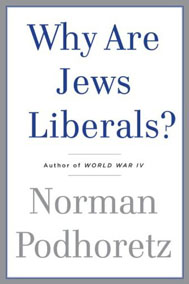 In his book, Why are Jews Liberals?, Norman Podhoretz tries to answer the aforementioned age old question. His initial question is from an economic standpoint. In general, Jews in the US are middle to upper class, a demographic that is frequently conservative, yet Jews are primarily liberal. Right away it is clear that Podhoretz is not asking about individual Jews being liberal; rather, he is curious and concerned about the overall trend. Before I opened the book, i had the same question, but asked it from a different angle. Judaism, specifically Orthodoxy, i a religion based on reverence for tradition. Although Orthodoxy is willing to change when necessary, it seems weird that most Orthodox Jews would want to have the opposite mindset in politics that they have for practicing religion.
 Podhoretz actually acknowledges my question, but uses the point to explain why they are liberal. Throughout history, going as far back as the Middle Ages, the Right, more specifically the Christian Right, was consistently antagonistic towards the Jewish people. Jews were persecuted, and their only way to be protected was to go through the embarrassing ritual of conversion. When the Enlightenment and then Marxism came along the Left finally gave Jews a way to be shielded without converting. All that Jews would have to do would be to get rid of the rituals that made them different. Eventually Reform Judaism came about to try and fulfill this need to be part of the "reason"able society. Podhoretz gives an interesting point here that although Jews thought they had found away not to convert they really hadn't. They found a way not to convert to Christianity, but they had to convert to the religion of reason instead.
Always seeing the Right as religious, and therefore anti-Jewish, in nature, Jews continued to be liberal after immigrating to America. This continued both from a conceived anti-semitism from the Right and the perceived acceptance from the Left, epitomized in FDR's tenures in office. In this way there had been a tradition for a very long time to hold onto liberalism.
Podhoretz then goes through recent Presidential elections showing the overwhelming support for the Democratic candidate, to a large extent irrelevant of the candidate's attitudes towards issues that relate to Jews, primarily Israel. Podhoretz laments that even though things have changed and there are significantly more proponents of Israel and other Jewish causes on the Right than there are on the Left, Jews continue to vote as liberals. In order to explain this Podhoretz rejects the traditional view of history, that Jews have historically been liberals so they continue to be so because liberalism has changed dramatically in recent years as has the entire political climate. All other demographics have changed why haven't Jews. Another answer he rejects is that liberalism has the Jewish value of tzedakah. While this may be true, the Torah and Rabbinic texts do not take any stance on political matters as they pertain to America today.
The answer Podhoretz comes to is striking. Many Jews have "converted" to liberalism, so much so that “where the Torah of contemporary liberalism conflicts with the Torah of Judaism, it is the Torah of liberalism that prevails and the Torah of Judaism that must give way.” While he bemoans this, I certainly hope that it is not true, and scared if it is. Just to be clear, I am not making no statement about any specific Jewish voters. However, I sincerely hope that whenever we, as thinking educated people, can determine the candidate that is best for Jewish issues, specifically Israel. I am scared to think that many Jews have predetermined their votes towards either candidate, based on party, without knowing how they will treat our own people. Certainly, other issues are very important, but it is due to the fact that we have always treated each generation like it could be the Jewish people's last that we have survived for so many centuries. To ignore the needs of our own people in the name of liberalism,or any other political philosophy for that matter, is not only foolish but destructive.
Wednesday, April 27, 2011
The Last Night of the Yankee Dynasty by Buster Olney

While it may be painful for Yankee fans (but fun for Yankee haters) Olney gives great insight into the dynasty, and the people that made it. His many years as a Yankee beat writer enables him to gives deep insight into Steinbrenner's money usage, Paul O'neil's passion, Jeter's consistency, Clemens' brashness, and Torre's professionalism. Olney's basic thesis is that when Steinbrenner stopped just throwing money at the team, but did so thoughtfully, getting the right players with the right drive, he was able to build the dynasty. After losing to the Dimondbacks, Steinbrenner went back to his old ways and spent money with abandon leading to a decade long drought of championships that only recently ended despite invariably having the highest payroll in baseball.
There were three traits that seem to regularly be part of the players in the dynasty which Olney describes: passion, work ethic, and goal driven. While these three traits manifested themselves in different ways with different players, everyone had passion for the game, a drive to always get better, and was in it for the team and not for their wallet. It was these traits and others that enabled the Yankees, as a team, to win a string of championships. When these virtues were gone, specifically the third one, that excellence was gone. While this is true for baseball, it is certainly true of just about everything else. Think about the best teachers, Rabbis, and doctors you've encountered. These certainly apply to them as much if not more than those Yankees. In his beautifully crafted tale of that fateful night Olney, not only gives us great insight to what makes a good team, but also what makes someone elite at anything.
Sunday, April 17, 2011
The Case For Israel By Alan Dershowitz

- This one should be on EVERYONE'S reading list. Dershowitz goes through 32 different claims that opponents of Israel make. He definitely is willing to criticize Israel but shows how Israel has consistently been one of the most moral countries in the ; even while being put in harder circumstances. Other than citing great facts to know and us, Dershowitz writes a profound argument for Israel that anyone who says they are a supporter of Israel should know.
- Other than being wildly valuable, it was also a great read. I read it in a day and a half because I just couldn't put it down.
- After I finished the book, I felt like I had a great argument for Israel, but it was almost too great. If the situation in the Middle East is such and open and shut case, then why are people so defiant otherwise? So I looked up reviews of the book. As with the issue at hand, it seemed like all the reviews were extremely positive or negative, and nothing in between. It seems that whichever side of the issue you are that viewpoint makes you look at the facts with completely different eyes that read every event differently. I can think of no other argument where each side completely reads every part of it in a different way. What is it about Israel that does this?
- Whatever it is, it makes peace look distant. In order to achieve it, a paradigm shift must be made by one or possibly both parties. I hope to a time where that can come to fruition.
Tuesday, April 12, 2011
"Exclusion and Hierarchy" by Adam S. Ferziger

Ferziger sees Rabbi Ezekiel Landau, the Nodeh BeYehudah, as the first step to what we call Orthodoxy today. Landau, for the most part made one huge distinction. Those that were ideologically different like reform and the Sabbateans were to be completely excluded from the community. He and then Rabbi Yaakov Emden believed that they should not even be buried with “Orthodox” Jews. However, those that were newly nonobservant, not because of ideological differences were fully part of Judaism. The next step towards “Orthodoxy” was Rabbi Akiva Eiger. He was more willing to work with the Reform because they are still Jews. After this Orthodoxy became defined differently in many communities. Rabbi Samson Rephael Hirsch deemed separation as the most effective way to keep those that were still religious Jews. At the same time he believed that he should be nice and work with them, but only on his terms. For example, he thought they could join his synagogue, but would not officiate at a wedding between an orthodox and a reform Jew, deeming it “intermarriage”. Rabbi Bamburger and the communities in Berlin and Frankfurt, chose a different method in dealing with other Jews (they were not practically the same, but their method was similar). Rather than completely separating them, they decided to create a hierarchy, where the other Jews were welcome but they were deemed “class B” Jews without certain right, like having leadership positions or performing circumcision.
As I see it, (as part of the Orthodoxy community) we practice a combination of exclusion and hierarchy, but we do more exclusion than hierarchy closer to the Hirsch model stated above. The conflict is clear, we want to be connected to all Jews, even if they have different views, but at the same time we believe that we are holders to the legitimate form of Judaism, not wanting to give legitimacy to other forms. However, I really think we lose a great deal of positive things by not accepting Reform as part of Judaism. With all the hate towards Jews of all forms that goes on in the world, if we were able to pool resources to be able to try and make the world a better place, be it through social action or Zionism, we would be able to create a semi-united front that would be so much stronger than it’s parts. Also, with the dwindling population of these sects due to assimilation, perhaps some would feel comfortable to go to an Orthodox synagogue.
No matter what, it is vitally important that we respect all Jews not only as people that were made in the image of G-d, but also as people that have shared in our heritage for thousands of years. May it come soon that we will all be able work together for common goals and not let other problems divide us as a people.
Subscribe to:
Posts
(
Atom
)